


Caitlin Blanchfield
Caitlin Blanchfield is a historian of architecture and landscape whose work examines the infrastructures of settler colonialism and material practices of resistance. Her research addresses the role of modernist land management and design practices in projects of dispossession and colonization in North America and across the reaches of the US empire, as well as the anticolonial architectures that unsettle them. Blanchfield received her Ph.D. in architectural history and theory from Columbia University and was a 2024-25 Mellon Postdoctoral Fellow in Architecture, Urbanism, and the Humanities at Princeton University.
She is currently working on her book, Unsettling Public Lands: Indigenous Sovereignty, Scientific Architecture, and the Question of Use, which offers a critical reading of modern architecture's instrumentalization in late-20th-century expropriation of Indigenous lands, while narrating a built environment history of Indigenous resistance. Other work includes collaborative investigations into the impacts of border infrastructures on Indigenous lands and multimedia projects on the management of architectural value, including the co-authored book Significant Impact: Contesting Surveillance Infrastructure on Indigenous Lands (Actar, 2025) and the collaborative exhibition and publication project Modern Management Methods: Architecture, Historical Value, and the Electromagnetic Image (Columbia University Press and The Shed, 2019).
Blanchfield was a founding editor of the Avery Review and served on the editorial board for the Journal of Architectural Education. The Graham Foundation, the New York State Council for the Arts, Dumbarton Oaks, and the Temple Hoyne Buell Center for the Study of American Architecture have supported her work. She holds an M.S. in Critical Curatorial and Conceptual Practices in Architecture from Columbia University and a B.A. in history from Oberlin College.
Academic Research/Specialty Areas
- Architectural history
- Architectural theory
- Material practice
- Politics of land
- Histories of colonialism
- Anticolonial practices
- Science, technology, and society
- Environmental history
Related News
- New Cohorts of Engaged Fellows Contribute to Campus Community-Engaged Learning Network
- The Graham Foundation Announces the Award of 56 New Grants
Classes (Selected)
- ARCH 5301 Theories and Analysis of Architecture I
- ARCH 1801/5801 History of Architecture I
Awards, Grants, and Fellowships (Selected)
- Princeton-Mellon Fellowship in Architecture, Urbanism, and the Humanities, Princeton University (2024–25)
- Graham Foundation Publication Grant, Graham Foundation for Advanced Studies in Fine Arts (2024)
- New York State Council for the Arts, Independent Project Grant (2022)
- Buell Center Fellowship, Temple Hoyne Buell Center for the Study of American Architecture (2022)
- Dumbarton Oaks Junior Fellowship (2021–22)
- Graham Foundation Research Grant, Graham Foundation for Advanced Studies in Fine Arts (2018)
- Inaugural Open Call Artist, The Shed (2018)
Exhibitions and Presentations (Selected)
- Modern Management Methods: United Nations Headquarters. In Open Call, curated by Emma Enderby. The Shed, New York. Cocurator and codesigner with Caitlin Blanchfield (2019)
- Cher. In Oslo Architecture Triennale, Norway. With Glen Cummings, Farzin Lotfi-Jam, Jaffer Kolb, and Leah Meisterlin (2016)
Publications (Selected)
- Significant Impact: Contesting Surveillance Infrastructure on Indigenous Lands (Actar, 2025). With Ophelia Rivas and Nina Kolowratnik.
- "Against Architectures of Degradation: Pōhaku and Protection on Mauna Kea," Landscape Review 21, no. 1 (2025): Landscapes and Seascapes of Connectivity in Moana Oceania.
- "Envirotechnical Lands: Science Reserves and Settler Astronomy," in Technical Lands: A Critical Primer, ed. Jeffrey Nesbit and Charles Waldheim, (Berlin: JOVIS Verlag, 2023).
- Modern Management Methods: Architecture, Historical Value, and the Electromagnetic Image (New York: Columbia University Press, 2019). With Farzin Lotfi-Jam.
Selected Work
-
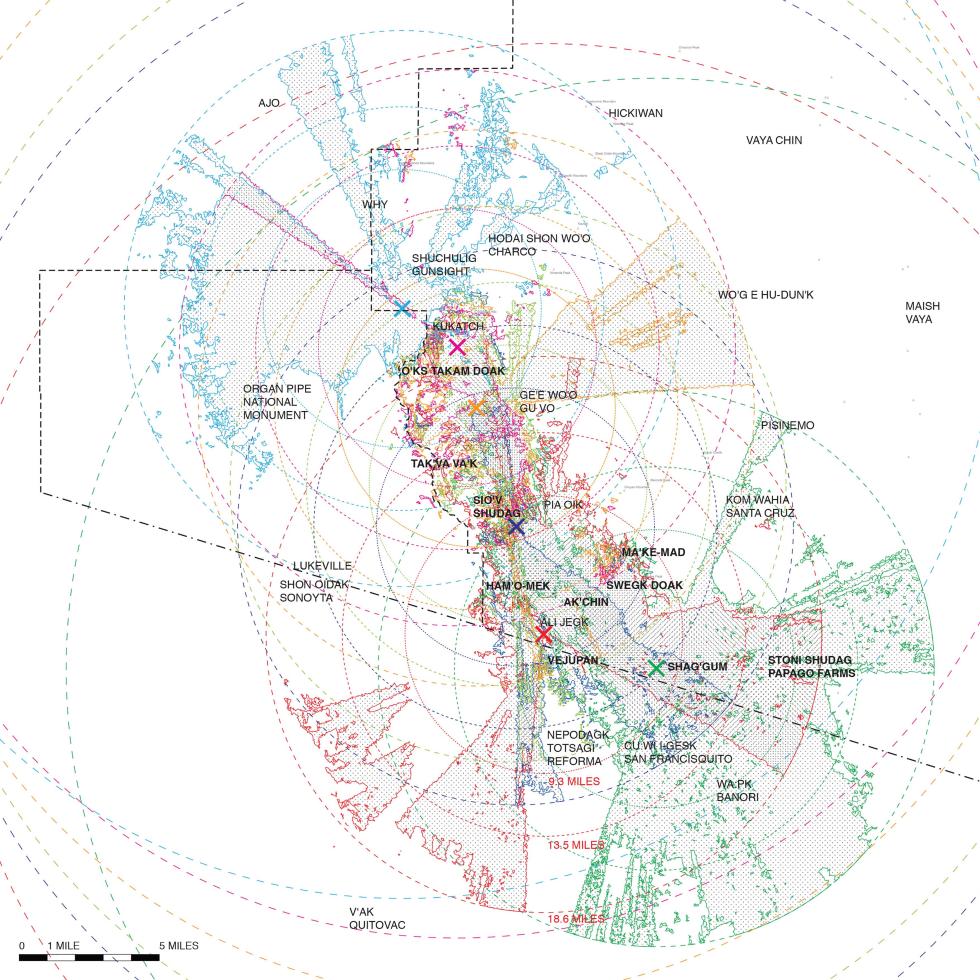
Map indicating radii and reach of proposed tower surveillance equipment in the landscape, Gu Vo District, Tohono O’odham Nation. image / provided
-
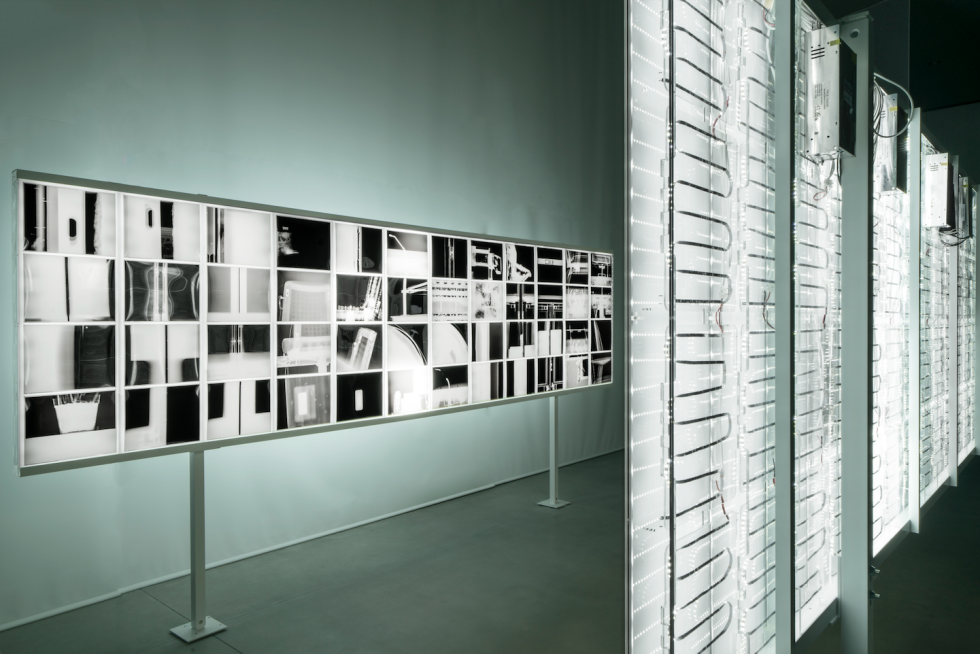
Modern Management Methods (2019), The Shed. photo / Kunning Huang
