


Historic Preservation Planning
Master of Arts in Historic Preservation Planning (M.A. HPP)
Historic preservation synthesizes design, history, public policy, cultural studies, science, and economics during the process of planning for the future of our cultural and natural resources, our communities, and ourselves. It is an exciting discipline with increasing relevance and urgency as we seek a sustainable future for people, cultures, and places everywhere.
Cornell was one of the first institutions in the country to offer graduate-level preservation classes and is internationally recognized as a leader in the field. Each year, employers throughout the world compete for graduates of the Historic Preservation Planning (HPP) program. Students who graduate from the intensive 60-credit program obtain invaluable skills and knowledge through the program's strong emphasis on theory and practice.
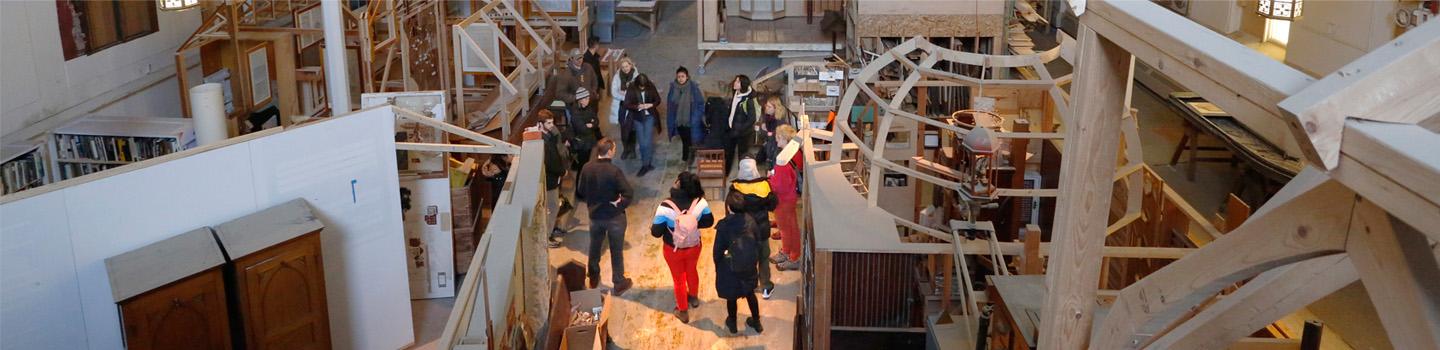
In addition to the core classes (Perspectives, Documentation, and Survey), students can choose from a variety of other preservation courses, such as Measured Drawings, Building Materials Conservation, Preservation Law, Preservation Economics, Cultural Landscapes, and more, as well as from the full range of courses offered in the department in planning, regional science, and real estate, and other classes across the university. Students are frequently out in the field doing exciting work for real-world sites and clients, as well as participating in multi-disciplinary design teams working with local communities.
For their final project, students write a thesis, which means significant research on a topic of the student's choosing. Some recent thesis topics are listed below. In addition to the classes mentioned above, the department organizes annual trips to various cities and preservation-related conferences, as well as spring work weekends at historic sites around the region. Cornell also helps the student arrange an appropriate internship in an agency or organization, in the U.S. or abroad, for the summer between the first and second years of the program, and contributes funding to help underwrite the experience.
Unique to Cornell, students in Historic Preservation Planning are immersed in and connected to the departments of City and Regional Planning, Landscape Architecture, and the Baker Program in Real Estate. Through courses and extracurricular programs, students collaborate, create strong social networks, and enhance their skills to be applied to the real world.
Graduate students from across Cornell who are not enrolled in the master's of Historic Preservation Planning program are strongly encouraged to apply for the Historic Preservation minor.
A list of recent student theses:
- "A Multitude of Little Worries: The Construction of Clarence S. Stein's Hillside Homes 1934 to 1935," Caitlin Benton (M.A. HPP '14)
- "Incentivizing Urban Conservation in Kolkata: The Role of Participation, Economics and Regulation in Planning for Historic Neighborhoods in Indian Cities," Kamalika Bose (M.A. HPP '14)
- "Modern Domestic Architecture in and around Ithaca, NY: The (Fallingwaters) of Raymond Viner Hall," Mayhar Hadighi (M.A. HPP '14)
- "A Case Study of Two Rail-Trails," Anisha Arabolu (M.A. HPP '14)
- "Emergency Employment, Public Enjoyment: Pre-New Deal Work Relief in Onondaga County, New York, 1931-1933," Grant Johnson (M.A. HPP '14)
- "Understanding Heritage Management- Case Studies with Interviews in the Field of Historic Preservation in Cambodia," Kothari Swapna (M.A. HPP '14)
- "Penn South: Union Financing, Urban Renewal, and the Fifty-Year Struggle to Retain Affordable Housing," Sarah Rodriguez (M.A. HPP '14)
- "East Meets West: Interpreting Chinese Historic Architecture in American Museums," Qing Cheng (M.A. HPP '15)
- "Heritage Education for School-Aged Children: An Analysis of Programs in Salem, Massachusetts," Emily Giacomarra (M.A. HPP '15)
- "The Preservation of the California Style in Argentina: A Case Study of Community Advocacy in Barrio Peron Buenos Aires," Maria Brito (M.A. HPP '15)
- "French Scenic Wallpaper in the American House Museum: A Panoramic View of its History, Production, Role in the Arts, Selection, Installation, Care, and Conservation, with a Special Focus on Lindenwald and Vizcaya," Jessica Follman (M.A. HPP '16)
- "The Preservation and Restoration of Tokyo Railway Station in the Process of Urban Redevelopment and Strategic Planning," Jiageng Zhu (M.A. HPP '16)
- "A Quantitative Analysis of Stone Buildings and Assessment of the Masonry Labor Market in New York State," Edward Fitzgerald (M.A. HPP '16)
- "An Analysis of Green Building Rating Systems in the Context of Historic Preservation," Rashmi Gajare (M.A. HPP '16)
- "Beacons of Civilization: Roadhouses of the Richardson Highway," Cassandra Woster (M.A. HPP '16)
- "'Con Vera Fide' (With True Faith): Sicilian-American Farming, Culture, and Identity in Woolwich Township, New Jersey, 1920-2010," Stephanie Armpriester (M.A. HPP '16)
- "Cheekwood: A Comprehensive Study of an American Country Era Estate and its Preservation," Jordan Cleek (M.A. HPP '16)
- "Preservation of Russian Orthodox Churches in the Cook Inlet Region, Alaska," Erin Frederickson (M.A. HPP '16)
- "Before Chatham Village: A History of Mount Washington and the Bigham Estate," Sean McGee (M.A. HPP '16)
- "History and Ahistory in the Rehabilitation of Pittsburgh's Market Square Historic District," Molly Soffietti (M.A. HPP '16)
- "Dinosaur National Monument: One-Hundred Years of Protecting an Anomalous Landscape," Ana Felissa Viana (M.A. HPP '16)
- "From Cod to Conservation: The Intersection of Tourism, The Cod Moratorium, and Telecommunications History in Newfoundland," Shannon Cilento (M.A. HPP '17)
- "The Fallacy of Demolition-Only Policy: An Examination of the Intersection of Race and Rightsizing in Baltimore, Maryland," Olivia White (M.A. HPP '17)
- "Historic Preservation in Honduras," Ana Castillo Bonilla (M.A. HPP '17)
- "Beyond Bricks and Mortar: Music, Memory, and Preservation on Nashville's Music Row," John Southern (M.A. HPP '17)
- "The Preservation of Public School Buildings in New York State's Small-City School Districts," Andrew Roblee (M.A. HPP '17)
- "Virtual Reality and Historic Preservation," Lei Yang (M.A. HPP '17)
- "An Evaluation of the Effectiveness of Preservation Plans in the Historic Core of Ankara, Turkey," Sena Kayasu (M.A. HPP '18)
- "Reforming Waqf in Pakistan: Creating a community-based platform for Historic Preservation," Maryam Rabi (M.A. HPP '18)
- "Rural Amenity-Based Economies, Turkey: A Case Study," Jennifer Rowan (M.A. HPP '18)
- "Home on the Range: Heritage-Based Economic Development in a Natural Resource-Based Economy," Michelle Van Meter (M.A. HPP '18)
- "The Demolition of Boston Garden: An Examination of Sports Stadia in Historic Preservation," Michael LaFlash (M.A. HPP '19)
- "Lasting Scars: Cincinnati's Urban Renewal in the West End," Claire Meyer (M.A. HPP '19)
- "Remembering The Alamo: Ways To Interpret What Remains Of The Alamo Plaza Courts In A Present-Day Context," Jessica Stevenson (M.A. HPP '19)
- "An Evolved Understanding: An Examination of the National Park Service's Approach to the Cultural Landscape at Chatham Manor, Fredericksburg and Spotsylvania National Military Park," Olivia Heckendorf (M.A. HPP '19)
- "The Implications of Real Estate Transactions on Historic Preservation Nonprofits: The Preservation Society of Newport County: A Case Study," Hannah Miller (M.A. HPP '19)
- "The Hope to Change a Neighborhood: The Obama Presidential Center, Jackson Park, and the Privatization of Public Space," Elizabeth Burns (M.A. HPP '19)*
- "Rural Transfer of Development Rights and Their Potential Impact on the Preservation of North Carolina's New Deal Homesteads," Carolyn Gimbal (M.A. HPP '19)*
- "Landscapes Tempered with Heritage: Reconciling Embedded Values and Preservation in a Connecticut Mill Village," Jillian Miller (M.A. HPP '19)*
*Thesis not yet available on the Cornell University Library website.
Graduate Minor in Historic Preservation Planning
Master's students from any discipline at Cornell (except HPP) are invited to enroll in the graduate minor in historic preservation planning.
