Biologically inspired materials, architecture, and design
Advanced manufacturing and 3D data visualization
Multiscale imaging and materials characterization
James C. Weaver runs the Wide-Field Electron Optics Laboratory and leads the Biologically Inspired Materials and Design Group. Working at the interface between zoology, materials science, biomedical engineering, and multimaterial 3D printing, his main research interests focus on investigating structure-function relationships in hierarchically ordered biological composites and the advanced fabrication of their synthetic analogues. He has played critical roles in the development of new model systems for the study of a wide range of biomineralization processes. He is an internationally recognized and award-winning scanning electron microscopist. With a strong history of national and international academic and industrial collaborations, he has coauthored more than 150 journal articles in the biological, physical, and geological sciences. His work has been featured on the covers of more than 40 scientific journals, and he has contributed to numerous collaborative art installations, which have been exhibited in Berlin, Boston, Frankfurt, London, New York, Paris, and San Francisco.
Weaver’s position at Cornell is a joint appointment in the multicollege department of Design Tech and Duffield Engineering’s Department of Materials Science and Engineering.
Academic Research Areas
Architectural design
Architectural technology
Collaborative practice
Digital media
Interdisciplinary art
Photography
Public art
Sculpture
Structures in architecture
Sustainability
Technology and art
Visual representation
Biologically inspired materials, architecture, and design
Advanced manufacturing and 3D data visualization
Multiscale imaging and materials characterization
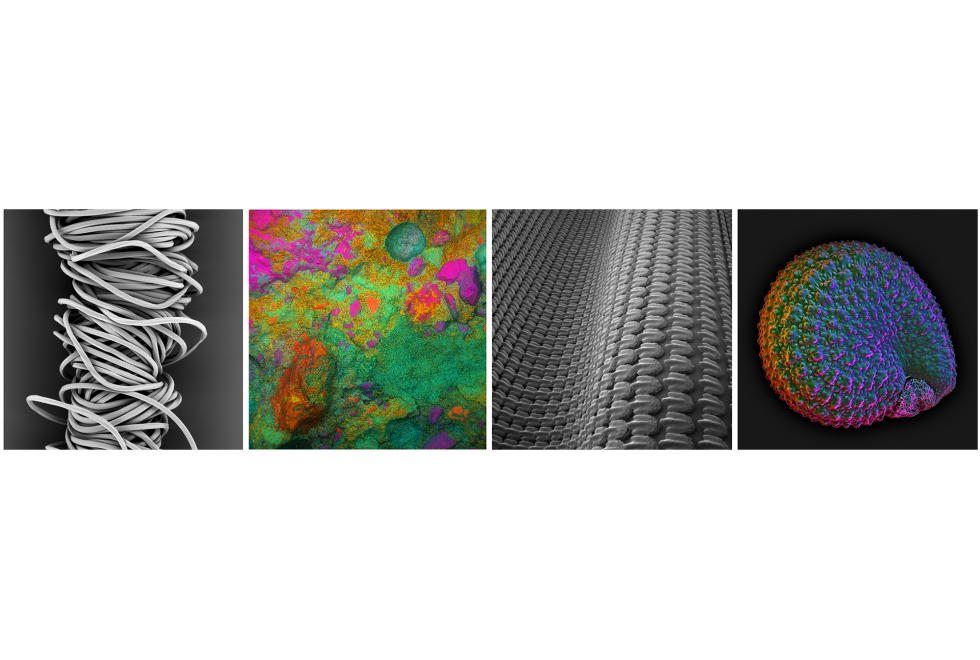
Multi-scale scanning electron microscopy research and development (from left to right): Structural analysis of elastomeric fibers (image area: 1 mm2); rapid shadow-free elemental mapping of fractured concrete (image area: 25 mm2); large-area high depth-of-field imaging of flexible 3D-printed shark skin-inspired low drag surfaces (image area: 100 cm2); polychromatic SEM imaging of a tessellated plant seed coat (image area: 1 mm2).
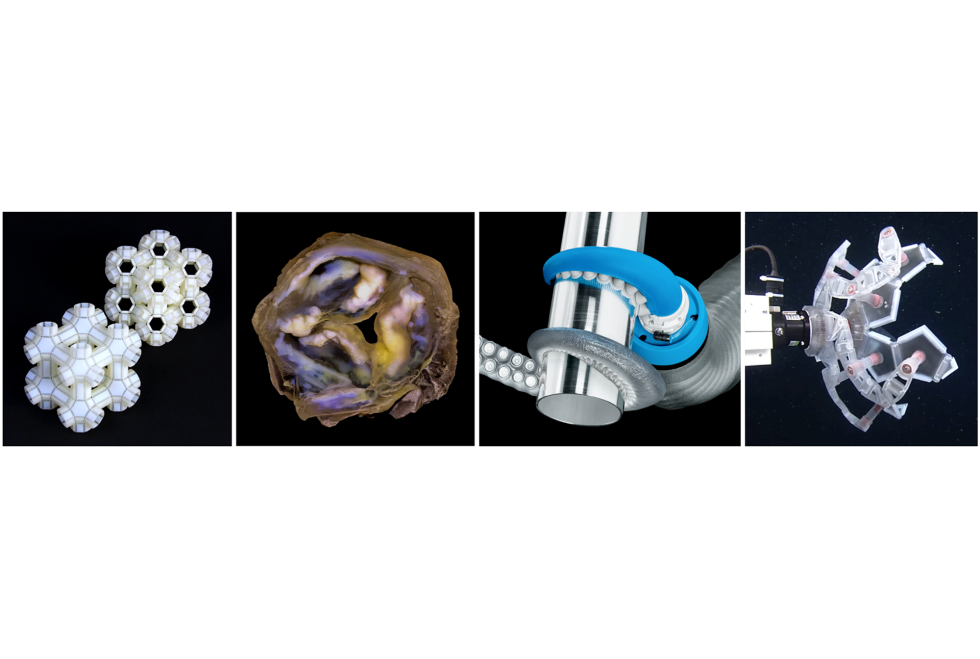
Advanced manufacturing and 3D data visualization (from left to right): Functional prototyping of auxetic metamaterials; variable modulus patient-specific anatomical models for pre-surgical planning; complex molding systems for the production of adaptable soft robotics; complex multi-component linkage systems and actuators.
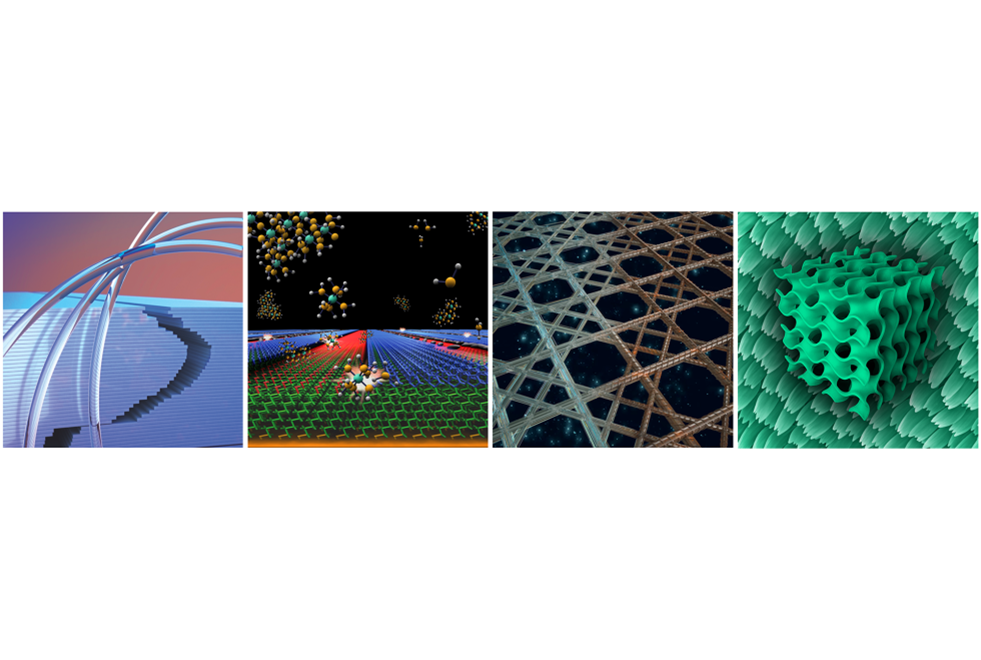
Biologically inspired materials development (from left to right): Damage-tolerant structural glasses; catalytic and structure-directing substrates for semiconductor nucleation and growth; high-strength-to-weight ratio lattice geometries; tunable photonic materials.
Publications
Design and Fabrication of a Parasite-Inspired, Millimeter-Scale Tissue Anchoring Mechanism
Maquignaz, Guillaume, Rebecca Zoll, Michael Karpelson, James C. Weaver, and Robert J. Wood. 2024. PNAS Nexus 3(12).
High-Throughput Segmentation, Data Visualization, and Analysis of Sea Star Skeletal Networks
Tomholt, Laura, Dominic Baum, Robert J. Wood, and James C. Weaver. 2023. Journal of Structural Biology 215 (2).
Mechanical and Hydrodynamic Analyses of Helical Strake-like Ridges in a Glass Sponge
Fernandes, Mariana C., Mahya Saadat, Pierre Cauchy-Dubois, Chihiro Inamura, Tali Sirota, Grace Milliron, Hamid Haj-Hariri, Katia Bertoldi, and James C. Weaver. 2021. Journal of the Royal Society Interface 18 (182).