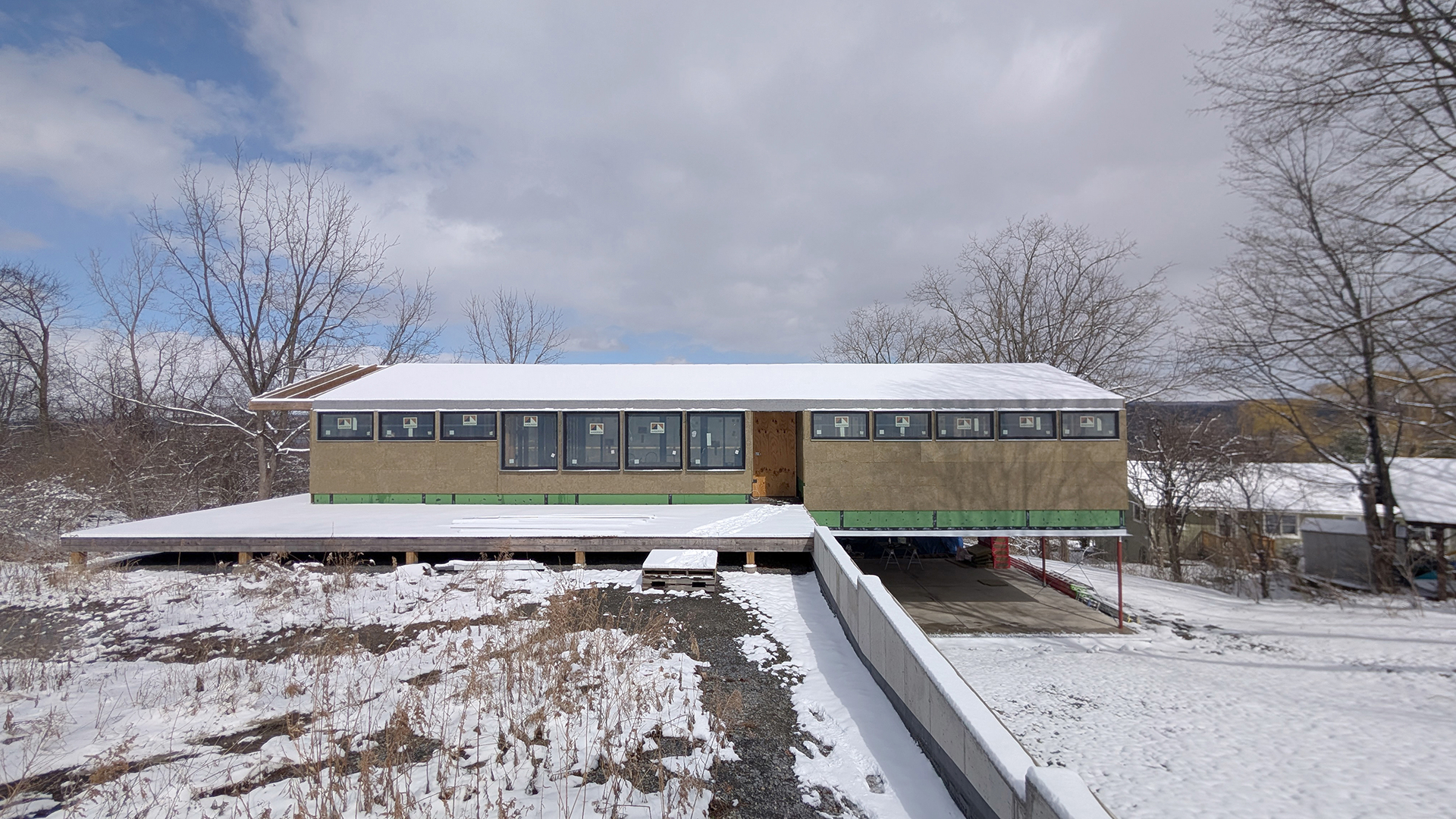
What happens when factors including durability, serviceability, reuse, and waste become central design considerations in a building project, ahead of a preconceived form that is later engineered?
To explore ways that such concerns can become design drivers for buildings, Assistant Professor of Architecture David Costanza has organized “Building Research,” this semester’s Preston H. Thomas Memorial Symposium on April 16 and 17 at the College of Architecture, Art, and Planning.
“In many design workflows — especially in education — a concept and form are developed first, and structural or material questions are addressed at the end, once the building has reached its formal and programmatic resolution,” explains Costanza. “Often, these early, formally driven designs are embedded with material and structural constraints that are directly tied to carbon-intensive building practices. Once a design includes something like a large cantilever, you have already embedded certain material and carbon decisions into the building. Starting with material systems and assemblies flips that process. The building’s performance informs the design from the beginning.”
Once a design includes something like a large cantilever, you have already embedded certain material and carbon decisions into the building. Starting with material systems and assemblies flips that process.
Symposium presentations are organized around three subthemes: affordability, performance, and carbon reduction. The featured speakers, drawn from an early-career cohort of academics in the United States representing a wide spectrum of approaches, will focus on projects they have built stateside that have successfully translated strategies for addressing these issues into real construction. Each will offer glimpses of how research can move from theory into built work — all while navigating building codes, developers, clients, and future occupants.
“Our academic system is excellent, but the research model often pulls us further and further away from buildings — toward an ever-expanding architecture discipline,” says Costanza. “The goal of the symposium is to fold that broader research back toward the building, which I argue should be central to the discipline.”
The presentations will focus on one project each in order to dive deeply into the challenges and trade-offs in these real-world scenarios, as well as the new knowledge generated in the process. Presenters include:
- Andrew Holder, The LADG (Los Angeles Design Group) / Pratt University
- Dan Spiegel and Megumi Aihara, SAW // Spiegel Aihara Workshop, Inc. / University of California, Berkeley
- Jenny French and Anda French, French 2D / Harvard University, Graduate School of Design
- Michelle Chang, JaJa Co / University of Southern California
- Sungwoo Jang, commonmatters / Syracuse University
- J. Roc Jih, Studio J. Jih / MIT
- Leslie Lok and Sasa Zivkovic, HANNAH / Cornell University
- Kyle Barker, Primary Projects / Harvard University, Graduate School of Design
- Andrew Colopy and Robert Booth, Cobalt Office / Rice University
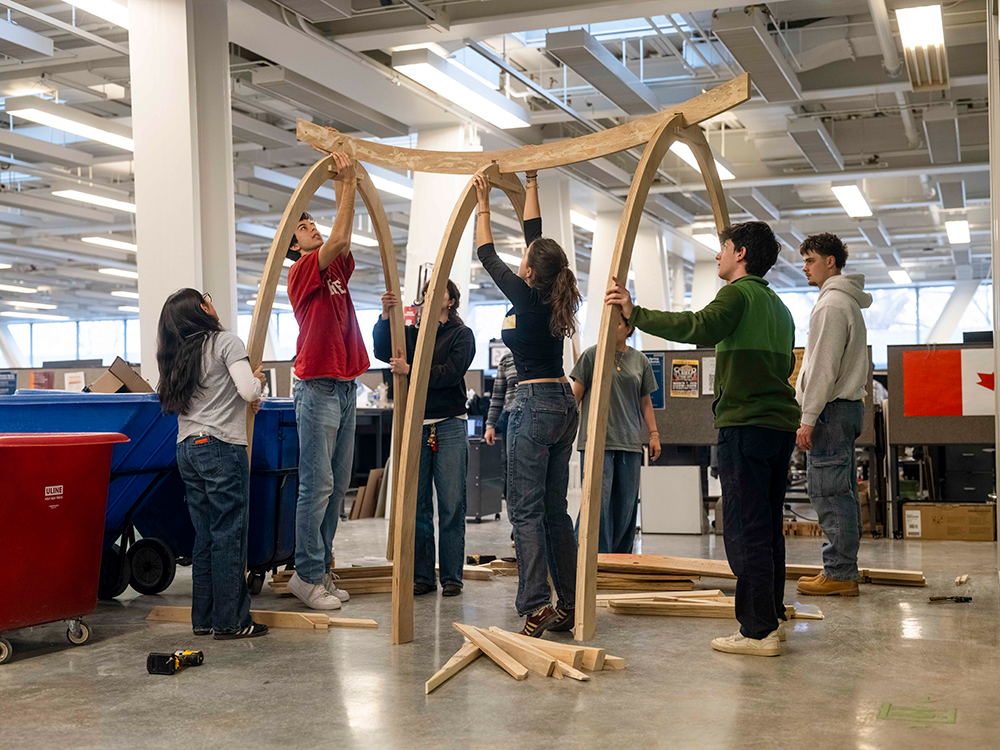
The symposium will also present an exhibition of six speculative projects produced by Costanza’s Building Construction Lab, running in parallel with the conference themes.

event
Apr 16–17
Preston H. Thomas Memorial Symposium: Building Research
This event seeks to examine the dual aspects of architectural inquiry: the meticulous study of the built environment and the creative act of building knowledge through construction.
Costanza says he hopes attendees can take away a renewed sense of excitement about buildings. “We all want our work to have an impact, but often it is overwhelming to figure out how to make that impact,” he acknowledges. “Instead of working through our disciplinary expertise, we often zoom outward and start looking at other disciplines seemingly more directly engaged with global issues. What I’m arguing is that we can make a meaningful impact through buildings themselves, through how we design and construct them. If we put our focus there, we can make an immediate difference.”
The Preston H. Thomas Lecture Series is funded through a gift to Cornell’s College of Architecture, Art, and Planning from Ruth and Leonard B. Thomas of Auburn, New York, in memory of their son, Preston. Events are free and open to the public. Previously this semester, the Department of Architecture has hosted lectures delivered by Marlon Blackwell, Joshua Ramus, and Michael Maltzan as part of the series.