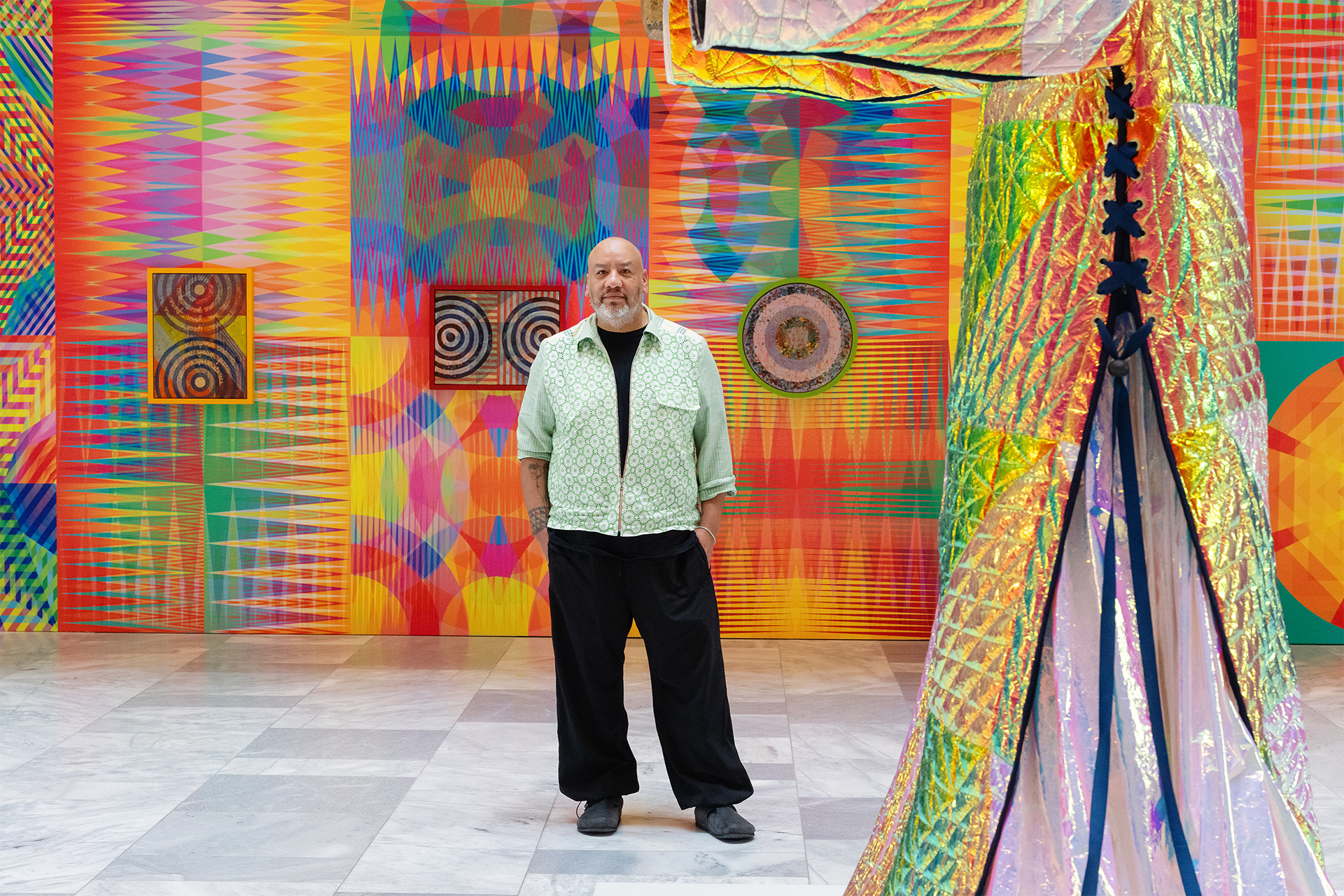
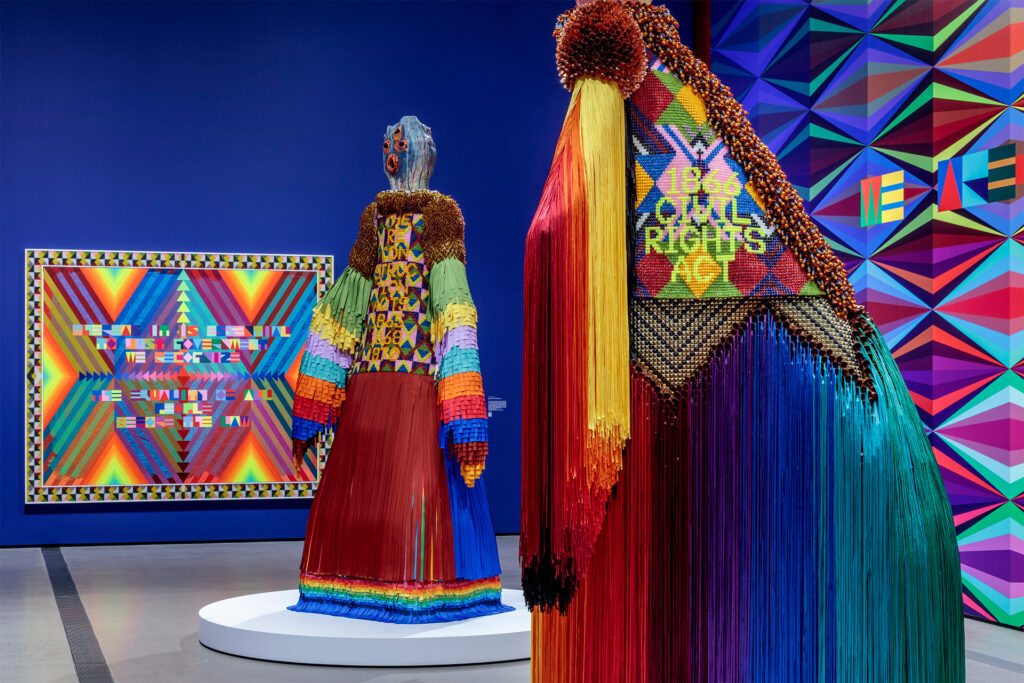
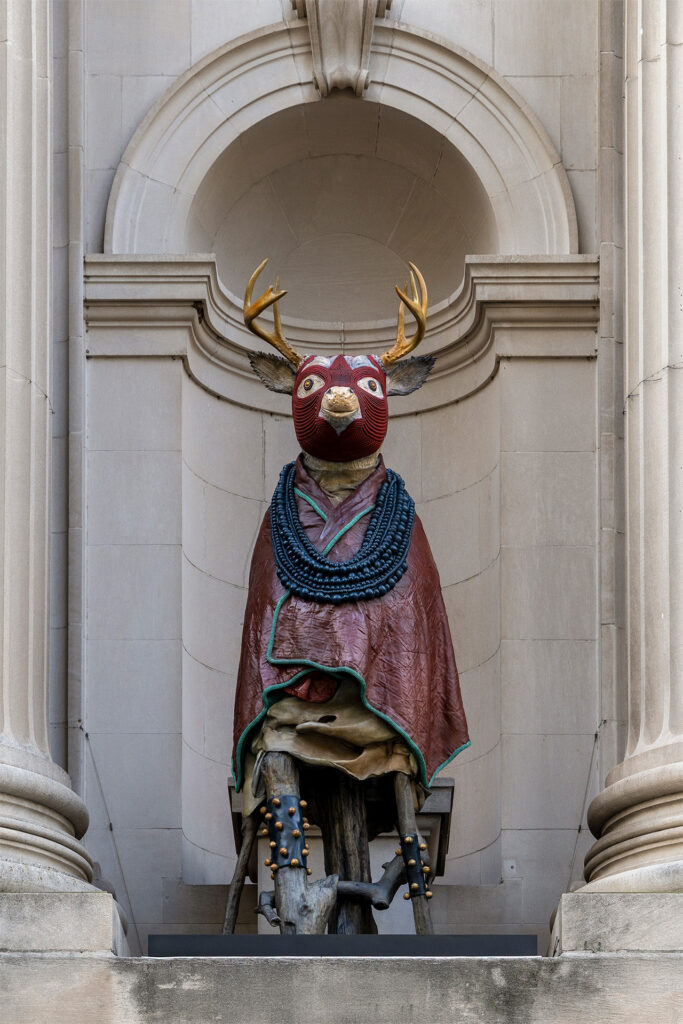
Installations of artist Jeffrey Gibson’s work offer kaleidoscopes of color across diverse materials and geometries. Detailed garments imply movement, even when displayed rather than worn in live performance, as they sometimes are. The pieces are so immersive, they come off the walls, often literally.
As the spring 2026 guest speaker for the John A. Cooper Visiting Artist Lecture Series at Cornell AAP, Gibson will give a public artist talk on March 24 in the Abby and Howard Milstein Auditorium. The series brings distinguished artists of particular renown to Cornell’s Ithaca campus to address art students and the art community through lectures, studio visits, seminars, and individual critiques with B.F.A. students. It is supported by generous gifts from John A. Cooper (B.F.A. ’97) and Heidi Cooper (’97).
In preparation for his visit, Gibson spoke with AAP about the methods, materials, and motivations that ground his work.
Molly Sheridan
Considering your degrees are in painting, I’m curious about the path to the work you’re making currently and the evolution of that vocabulary across so many materials.
Jeffrey Gibson
For a lot of young artists, you don’t really know where your career is going to take you or even if you’re going to have a career. I feel like I was adding materials almost as a way of being literal about what I was trying to communicate about cultural lineage and practices. It was out of frustration that I started using rawhide and materials that were sold at powwows for regalia. The paintings were taking that idea and conceptually abstracting it, but when I started using those materials and showed that work to audiences, they immediately knew that it was not coming from European Western history. A lot of that work was done by the materials, and that was the attraction.
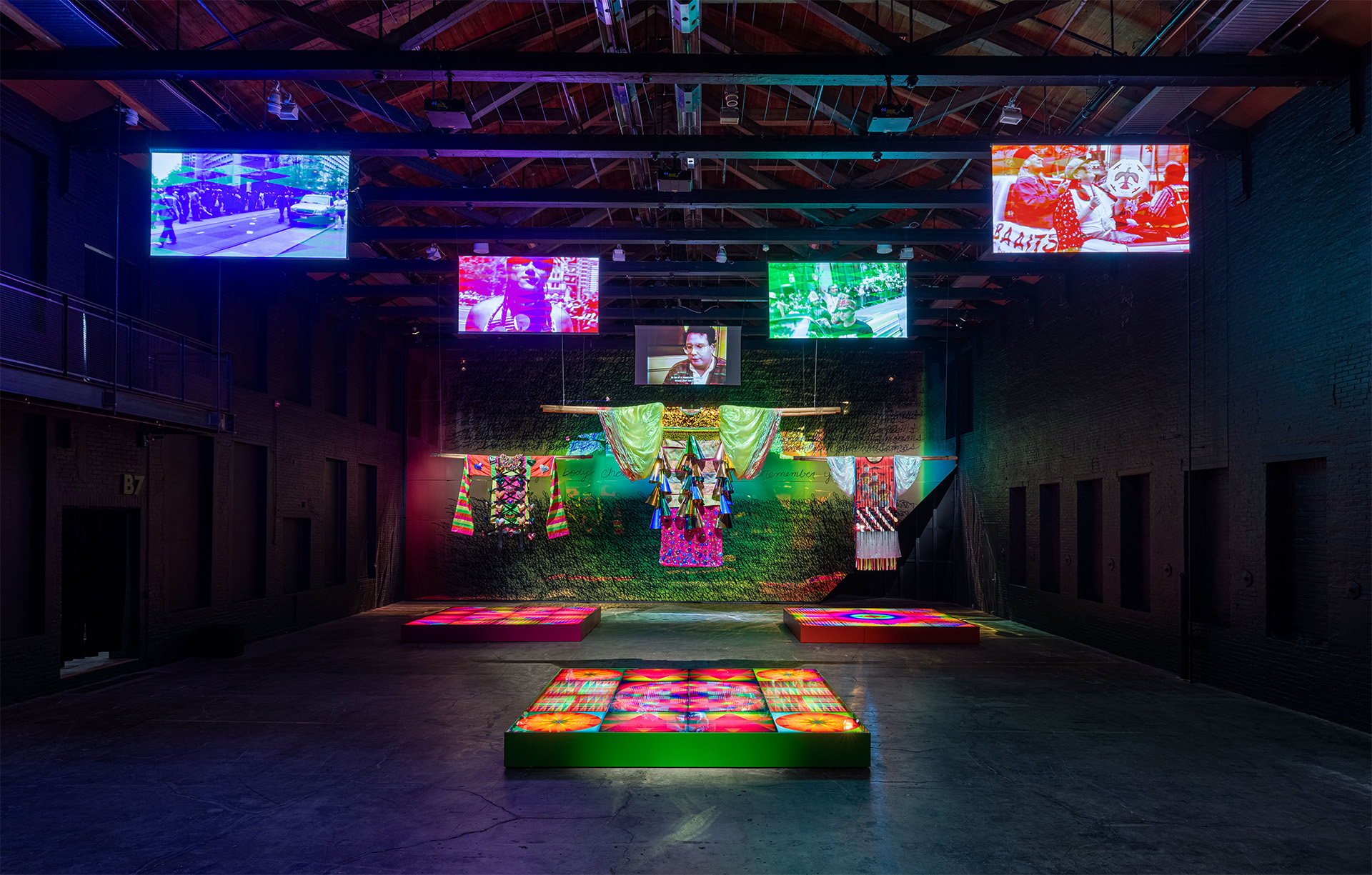
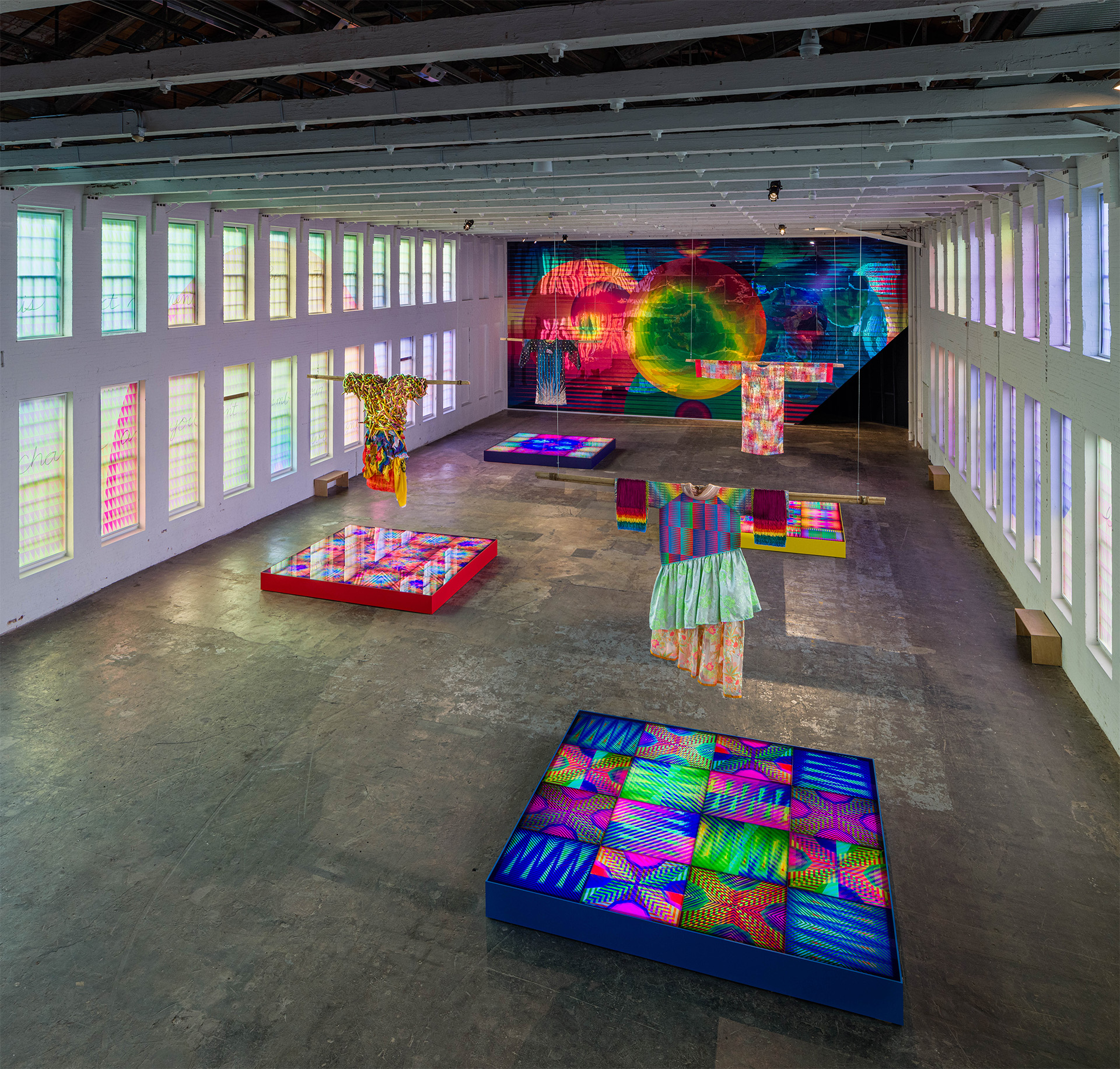
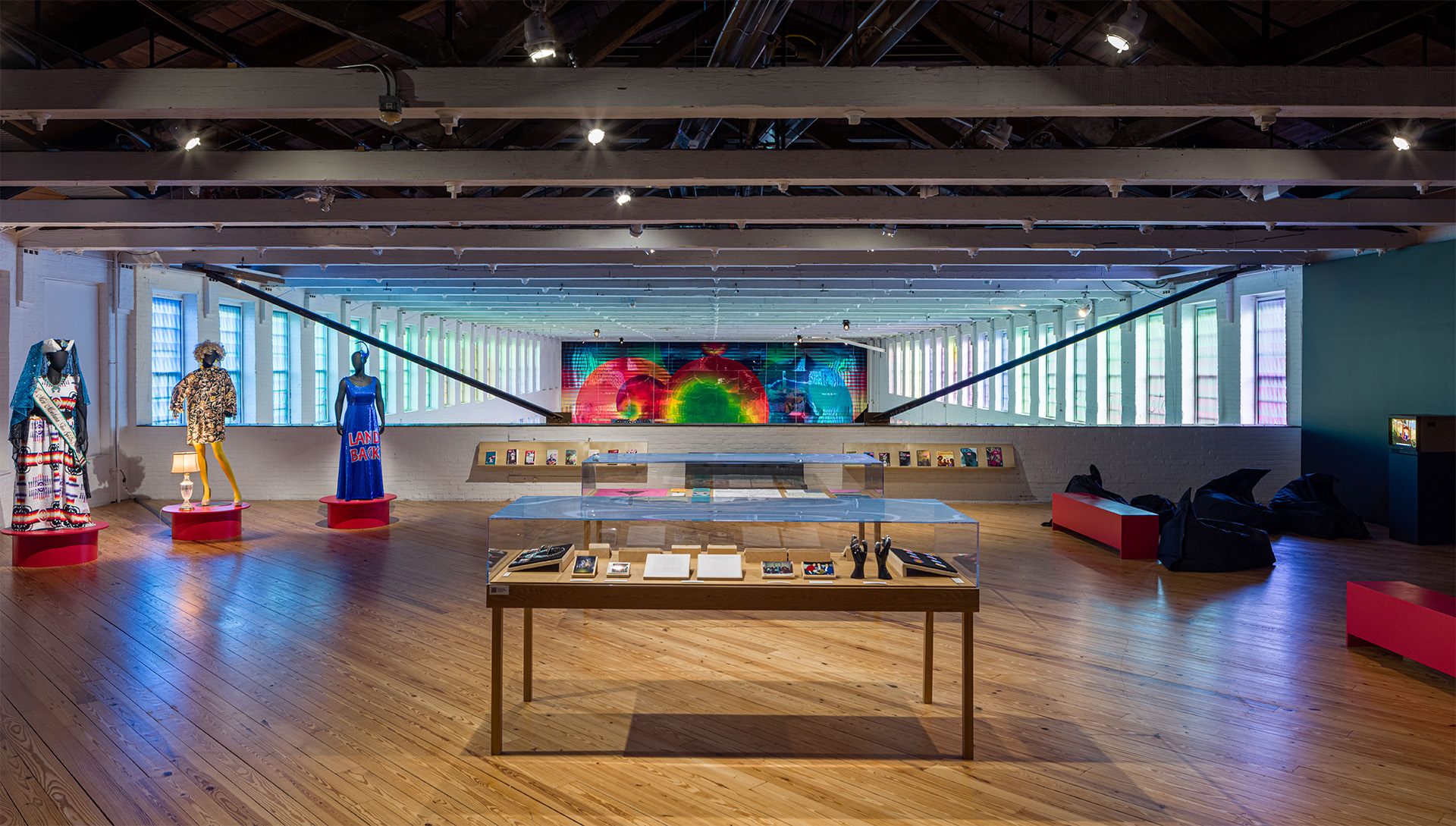
Really, I’m a process-based collage artist who likes experimenting with materials. How could I make them perform differently? That set the ball in motion for everything that comes after. I’m using a lot of materials that originate within dance, music, or performance. Eventually, I wanted to see things in motion. I wanted things to have sound. Most recently, with the installation at MASS MoCA, it didn’t make sense that I would fill that space with hundreds of objects. It made sense to try to think about how to draw out the references and to create more of an atmospheric installation.
Molly Sheridan
Did you have to struggle with that literalness? As you acknowledge, these materials were coming with their own meaning and the viewer could see that and make connections of their own.
Jeffrey Gibson
If you imagine that there’s a line between cultural understanding or cultural meaning, the materials were able to volley the ball to the other side. Then as an artist, the challenge is: now I want to volley it back. It’s more about complicating that line or existing within the space of that line that I think is of interest to me. All these years later, that challenge still exists. No matter how abstract I get, no matter how much I put down the references, the way that identity works in American culture, in particular, is that that’s never going to leave me. And other people’s perspectives inform my own perception of myself. The fact that I’m Native American is never going to leave the room, and for better or for worse, that’s the way that identity operates. But I would say it starts off as a nuisance, and then it becomes a challenge. Then it’s a place of invention.
Molly Sheridan
Making art takes time, but in your work that time investment is evident – in the detail and the scope combined. That fully beaded punching bag alone! Is that nod to time intentional?
Jeffrey Gibson
For sure. I wanted to make an impact in the art world, so there needed to be more than just a handful of works produced each year. I assembled a team, and the things that I used to work on independently, now someone on the team might work on 35 hours a week for three months. The effect of both the evidence of the hand and the understanding of how laborious something is, it situates the viewer. It’s so evidently a crafted, intentional object. That translates into the experience of looking at them, very much so.
Molly Sheridan
What role does music, both sonically and lyrically, play in your process and the finished work?
Jeffrey Gibson
It started by incorporating my embrace of music on a personal level – how much I enjoy having a soundtrack in my life. Clubs and the subcultures that exist within clubs had been so important to me, so I started looking at that particular music. Then I started looking at Christian hymns. Both of my grandfathers were Southern Baptist ministers in their native languages in Mississippi and in Oklahoma. I remember going to their churches and hearing Christian hymns sung in Cherokee or Choctaw and thinking about whether there were any differences in the translation of languages. Those lyrics have shown up in a lot of my work as well. By that point, I knew that I had a relationship with music as a visual artist – the desire to play with sound and to make music. It really has to do with how sound functions as a physical healing mechanism. Even in those clubs of the ’80s and ’90s, that’s what it was doing. It was a unifying mechanism that brought healing and stabilized a space for people, even if only temporarily.
Molly Sheridan
Standing where you are in your creative life, what piece of advice would you share with artists just beginning to establish themselves?
Jeffrey Gibson
They’re not the most comforting notes! I wish I could tell students that the art world was an equitable place. I wish I could tell them that it was based on one’s talent. When you decide that you want to have a career as an artist – exhibiting your work, engaging with the public – you have to want to engage with that. If I were striving for people to always like my work or to understand my work, especially early on, I would have been very disappointed. When I see students or young artists looking for that space of understanding, it takes a lot of energy to give over to total strangers. It sounds like a cliché, but you really do have to come back to what is really important to you. Why does it have to be a painting? Why does it have to be a performance? Why does it have to be music? And sometimes that takes a really long time to figure out.
People who meet me may not realize, but I didn’t have commercial gallery representation until I was 40. Up until I was 40, I don’t think I had health insurance. I was working 70, 80 hours a week, and I was broke all the time. I’m turning 54 in March, so I feel like I’m just coming into the middle of it not being new anymore.
Attend the Lecture
John A. Cooper Visiting Artist Lecture Series featuring Jeffrey Gibson
March 24, 2026
5:15 p.m.
Abby and Howard Milstein Auditorium, Ithaca