Symposium
Location
Virtual
Contact the Organizers
Labib Hossain
lh636@cornell.edu
Ecem Saricayir
es939@cornell.edu
Overview
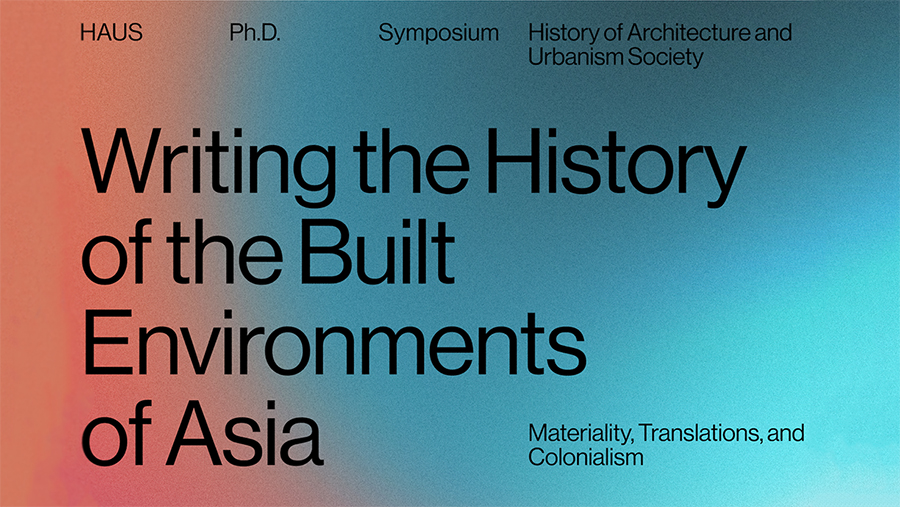
Organized by Cornell University’s History of Architecture and Urbanism Society (HAUS), “Writing the History of the Built Environments of Asia: Materiality, Translations, and Colonialism” seeks to discuss new approaches that prioritize material cultures in studying the colonial built environments of Asia. We invite graduate students to rethink together the previously established disciplinary and geographical boundaries of this large continent by focusing on cross-border connections, extractive economies, global and local translations, and multispecies entanglements.
The term “Asia” has been used to refer to vast and different lands, including those in West Asia, Central Asia, South Asia, and Southeast Asia. In our reimagination, knowledge on Asia acknowledges the multiplicities of these different lands, as well as connections, monetary exchanges, and translations within, into, and from it. Part of our intention in broadening the scope of our understanding of Asia and the built environment, both conceptually and methodologically, is to extend beyond the previously limited frameworks consisting of architecture and landscape.
We call for studies of the environment that include previously understudied material aspects and agents of the built environment. This material ecology includes but is not limited to fluid or abject materialities, living and dead organisms, and apparatuses that complicate the constructed categories, which would unsettle established official narratives, colonial efforts, and human-centric ontologies.
The workshop on April 21 is open to symposium speakers and members of HAUS. The symposium on April 22 is open to the public.
April 21 Workshop Schedule
5–5:05 p.m.: Introduction
5:05–5:25 p.m.: Global South Approaches: Non-Aligned Modernism by Anoma Pieris, The University of Melbourne
5:25–5:45 p.m.: Following the Footnote by LEE Kah-Wee, National University of Singapore
5:45–6:05 p.m.: Third World Communicationism by Farhan Karim, University of Kansas
6:05–6:15 p.m.: Break
6:15–6:45 p.m.: Parallel Discussions
6:45–7:05 p.m.: Report
7:05–7:10 p.m.: Conclusion
April 22 Symposium Schedule
Keynote Speaker
12–1 p.m.: Nida Rehman, Lucian & Rita Caste Assistant Professor, School of Architecture, Carnegie Mellon University
1–1:15 p.m.: Break
Panel 1
1:15–1:35 p.m.: “Power of Planning: Early 20th Century Pacification and Public Works in the Philippine Islands” by Chrionni Bernard Decrepito, University of San Carlos
1:35–1:55 p.m.: “Water and Memory: Fountains, Heritage, and Infrastructure in Istanbul and Tehran” by Sharon Mizbani, Yale University
1:55–2:15 p.m.: “Infrastructuring Migration: The Logistics of Labor in the East Coast of Sumatra” by Robin Hartanto Honggare, Columbia University
2:15–2:30 p.m.: Response by Ecem Saricayir (HAUD)
2:30–3 p.m.: Discussion
Panel 2
3–3:20 p.m.: “Canal Colonies in Punjab: Labor, Property, and Water in Colonial India (1842-1935)” by Javairia Shahid, Columbia University, History of Architecture
3:20–3:40 p.m.: “‘Catastrophic’ sand not water: Prognostic conceptualization of riverine sand as ‘problem'” by Saumya Pandey, Chr. Michelsen Institute, Norway and University of Ghent
3:40–4 p.m.: “Restoration as a Collaborative Enterprise: The case of Bathing-Ghats in Nineteenth Century Mathura” by Paridhi David Massey, Ashoka University
4–4:15 p.m.: Response by Labib Hossain (HAUD)
4:15–4:45 p.m.: Discussion