Lecture
Location
Abby and Howard Milstein Auditorium
Milstein Hall
Contact
Department of City and Regional Planning
(607) 255-4613
Abstract
Colleges and universities have quietly become central players in today’s knowledge economy—emerging as major landholders, employers, healthcare providers, and even policing agents within communities nationwide. In this lecture, Davarian Baldwin examines how the physical form of “the campus” operates as a planning tool that transforms neighborhood blocks into engines of university and corporate wealth through land control, labor management, and the semi-private governance of host communities. Drawing on work from his Smart Cities Research Lab, Baldwin reveals how campuses convert laboratories into tax shelters for investors and graduate workers into wage-suppressed apprentices—while also spotlighting grassroots efforts to resist these trends. What are the implications of living in the shadow of a planning model Baldwin calls the “UniverCity”?
This event is cosponsored by The Einhorn Center for Community Engagement, the Society for the Humanities, and the Committee for the Future of the American University.
Biography
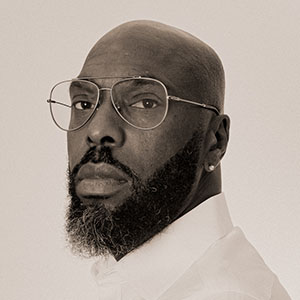
Davarian L. Baldwin
Davarian L. Baldwin is the Raether Distinguished Professor of American Studies and the founding director of the Smart Cities Research Lab at Trinity College. His teaching, research, and advocacy explore the politics of global cities, with a focus on the diverse and marginalized communities striving to build sustainable lives in urban environments—from the United States to London, Rotterdam, and Bangkok. Baldwin is the award-winning author of several books, including In the Shadow of the Ivory Tower: How Universities Are Plundering Our Cities. He also served as a consultant and text author for The World of the Harlem Renaissance: A Jigsaw Puzzle (2022). His commentary has appeared in major outlets such as NBC News, BBC, HULU, USA Today, The Washington Post, and TIME magazine. Baldwin was named a 2022 Freedom Scholar by the Marguerite Casey Foundation in recognition of his scholarship and public engagement on issues of racial and economic justice.